
AIdataNewsGlobal General Briefing: Synaptics Astra SR200 series brings custom DRAM and up to 400 GOPS to on-device multimodal AI
For readers of the AIdataNewsGlobal General feed, the notable claim is that small controllers can keep richer multimodal AI execution on-device even when traditional memory and compute budgets become restrictive. Synaptics Astra SR200 series xMCUs are built around that framing: the design mixes multiple accelerator and processor paths with custom memory capacity that can scale to hundreds of Mbytes.
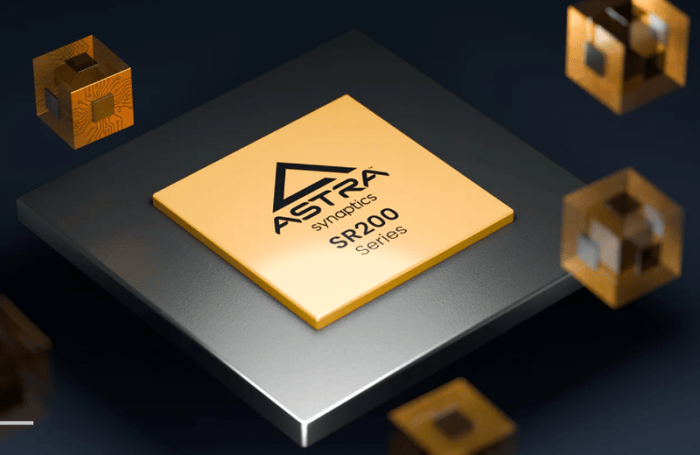
Architecture at a glance
The platform combines several compute paths rather than relying on one processor. At the top is the Torq AI engine, which incorporates the transformer-capable Coral NPU from Google Research and is linked with the cited upper inference figure of up to 400 GOPS. General-purpose cores come from Arm: Cortex-M85 and Cortex-M52. The specification also includes vision functions, audio functions, and security functions rooted in hardware.
The memory story is also layered. SRAM capacity is described as up to 8 Mbytes, and it is paired with high-bandwidth, extensible, custom DRAM. Synaptics states that the combination lets affected workloads run at one-third the power of typical system DRAM. The larger memory envelope is presented as the mechanism that lets richer multimodal workloads and bigger models remain entirely on-device.
Key numbers from the specification
| Data point | Exact figure or count | Why it matters here |
|---|---|---|
| Highest inference throughput cited | up to 400 GOPS | Upper AI compute ceiling associated with the Torq AI engine and Coral NPU. |
| On-chip SRAM ceiling | up to 8 Mbytes | Forms the first tier of the memory hierarchy before DRAM expansion. |
| Custom DRAM scalability | hundreds of Mbytes | Provides the capacity path for larger on-device model and multimodal use. |
| Power comparison for the memory arrangement | one-third | Synaptics frames the paired SRAM and custom DRAM path at one-third the power of typical system DRAM. |
| Product line count | three | Separates voice-first, vision-plus-display, and highest-throughput edge variants. |
Checklist: what the Astra SR200 series includes
- Heterogeneous compute: Arm cores are mixed with dedicated AI and media paths instead of presenting a single-core solution.
- AI accelerator path: Torq AI engine and Google Research Coral NPU are cited for up to 400 GOPS.
- Core set: Cortex-M85 and Cortex-M52 are named as part of the Arm CPU configuration.
- Media and security: The description includes integrated vision, audio, and hardware-rooted security features.
- Memory hierarchy: up to 8 Mbytes of SRAM works alongside custom DRAM scalable to hundreds of Mbytes.
- Shared platform: three product lines are pin-compatible and share a common hardware base and SDK.
Product tier breakdown
| Model line | Compute figure | Differentiating functions |
|---|---|---|
| SR210 | 200 GOPS | Targets always-on voice and sensing. |
| SR230 | 300 GOPS | Adds vision and display paths, plus optional audio. |
| SR250 | 400 GOPS | Brings dual vision and display paths to demanding edge applications. |
Read as a sequence, the lineup moves from a low-throughput voice and sensing option to a mid-tier media expansion and finally to the top compute setting. The 200 GOPS figure belongs to SR210, the 300 GOPS figure belongs to SR230, and the 400 GOPS figure belongs to SR250. The top number is also the highest figure associated with the broader Astra SR200 series family.
FAQ for Global AI and data readers
Q1: What problem is this platform addressing?
A: The stated problem is memory and compute constraints in conventional small controllers. The Astra SR200 series answer is a heterogeneous on-device platform with custom DRAM and AI acceleration.
Q2: Where does the up to 400 GOPS claim come from?
A: The claim is tied to the Torq AI engine and its use of Google Research's transformer-capable Coral NPU.
Q3: Why is custom DRAM central to the message?
A: Because it provides the scalable memory envelope—up to hundreds of Mbytes—that supports larger models and richer multimodal workloads without leaving the device.
Q4: How many model lines are described?
A: three lines are listed: SR210, SR230, and SR250, with a shared software development kit and compatible pin layouts.
Q5: What is the power claim?
A: Synaptics says the tiered memory design can run workloads at one-third the power of typical system DRAM.
Q6: What should readers compare across the tiers?
A: Compare 200 GOPS, 300 GOPS, and 400 GOPS; then compare always-on voice and sensing, added vision and display, and dual vision and display paths.
What to watch next
The source text gives architecture and product-line facts, not additional performance measurements. For follow-up monitoring, the useful checklist is whether the three pin-compatible lines continue to be described with the same shared SDK and hardware base; whether future disclosures preserve the up to 8 Mbytes SRAM and hundreds of Mbytes custom DRAM details; and whether additional information substantiates the one-third power comparison in real multimodal AI workloads using the Torq AI engine, Google Research Coral NPU, Arm Cortex-M85, and Arm Cortex-M52 configuration.
For AIdataNewsGlobal General readers, the concise takeaway is a scale path: memory capacity becomes the variable that allows multimodal AI to remain on-device, while compute figures define the line boundaries. The key constants to cite are up to 400 GOPS, up to 8 Mbytes, hundreds of Mbytes, one-third, and the three model tiers SR210, SR230, and SR250.