
AIdataNewsGlobal LLMs Guide: How to Interpret Kimi K3.1 Pro's Arena Agent Score Improvement
By David Nakamura, AI & Data News
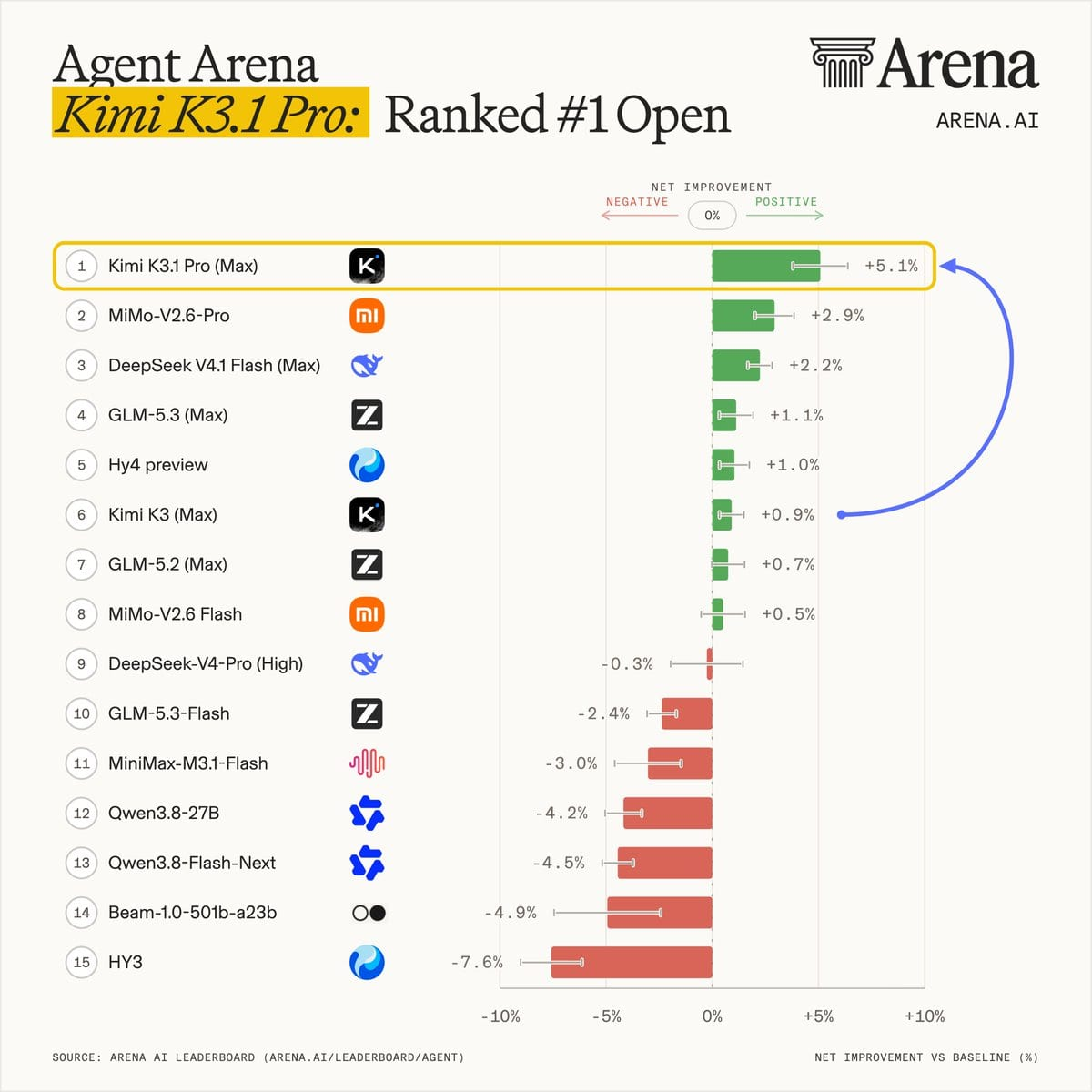
The Arena update shows that Kimi K3.1 Pro (Max) reached a +5.1% net improvement over more than 17,500 real long-running agent task sessions, up 4.2 percentage points from Kimi K3 (Max)'s +0.9%. For developers and product owners, the headline is not that K3.1 Pro “won a leaderboard,” but that its agent behavior improved on human-observed signals. Use the score as a screening signal, then test tool use, reliability, cost, and safety before replacing a production model.
What does the Arena leaderboard measure?
The short answer: Arena is closer to a real-session signal than a fixed exam. Its net improvement metric is meant to describe how much better outcomes are compared with the average model under evaluation, using signals from live agent tasks. Arena’s methodology notes that signals can include explicit user confirmations, praise, complaints, corrective instructions, and execution errors; this makes it useful for interactive coding and tool-use agents, but not a substitute for domain-specific acceptance tests. In the update, Kimi K3.1 Pro (Max) scored +5.1%, while Kimi K3 (Max) had +0.9%. The 4.2 percentage point gap is most meaningful when your workload involves multi-step agent behavior, not single-turn chat.
Which Arena metrics changed for K3.1 Pro?
Read the metrics as separate product risks. Bash Reliability is about command execution; Praise vs Complaint is about user experience; Steerability is about recovery after correction; Confirmed Success is about whether users marked outcomes as acceptable. The table below uses only the figures in the Arena update.
| Metric | Kimi K3.1 Pro result | Comparison | Engineering takeaway |
|---|---|---|---|
| Bash Reliability | +7.9%, ranked first among open models | Previous K3: -4.5%, ranked 13th | Check shell and tool-call failure modes before granting execution access. |
| Praise vs Complaint | +7.7% | Previous generation: +1.3% | Run human preference tests on error handling and response tone. |
| Steerability | +6.5%, open model first | Leaderboard signal | Test whether the model obeys follow-up constraints instead of rerunning old plans. |
| Confirmed Success | +3.9%, ranked fourth | Previous generation: +3.8% | A positive delta is real but narrow; validate completion with logs and tests. |
Why architecture and access matter for deployment
Moonshot AI describes Kimi K3.1 Pro as a Mixture-of-Experts (MoE) model with 2.8 trillion total parameters, about 104 billion active parameters per inference, and an approximately 1,000,000-token context window. The same release notes point to native multimodal capability and stronger performance in coding, 3D creation, financial research, factuality, and complex agent tasks. The weights are open for download on Hugging Face, which changes the evaluation burden: teams can inspect the model card, tokenizer behavior, memory profile and license terms, but they also inherit responsibility for serving such a large sparse model. A practical rule is to treat the open weights as a capability experiment first, not an immediate replacement for a managed, hardened production endpoint.
Cost and operational signals beyond the leaderboard
For many LLM teams, cost per completed task matters more than a model’s headline context length. Third-party API trackers list Kimi K3.1 Pro pricing at about $2.00 per million input tokens and $10.00 per million output tokens, according to Artificial Analysis. This is still only one pricing view; cached input, throughput, rate limits, and region can shift the final bill. The practical action is to calculate “cost per accepted task,” not “cost per thousand tokens.” A model that completes more agent loops with fewer corrections may win even if its per-token price is higher. If the 1M-token context window pulls in long logs, repos, or financial documents, prompt construction and chunking strategy may become the real cost driver.
A practical rollout checklist for agent teams
- Recreate the Arena signal on your own tasks. Use coding, shell execution, repository editing, and tool-use workflows where previous K3 behavior is measurable.
- Track four private metrics. Track: first-pass success, human correction rate, shell execution failure rate, and time to accepted completion.
- Test steerability, not just output quality. Include prompts where the user changes requirements mid-task and asks the model to stop, re-plan, or avoid commands.
- Validate long-context behavior. If you use the approximately 1,000,000-token window, run retrieval and summarization tests to see whether quality decays across long sessions.
- Use the open weights as an experiment. Hugging Face download access allows local evaluation and research, but production deployment should include sandboxing, secret isolation, and audit logs.
Common pitfalls when reading the update
- “Open model first” is not “best for every workload.” It means leading the open subset on the measured Arena signals, not guaranteed superiority across all agent tasks.
- Net improvement is not absolute accuracy. A +5.1% figure describes relative improvement over the evaluation baseline; it cannot be read as a 5.1% success rate.
- Leaderboard mix matters. More than 17,500 real long-running sessions provide scale, but tasks, users and domains are not evenly distributed across every engineering stack.
- Better steerability can increase risk. A model that follows corrections more reliably may also be trusted too quickly; keep approvals for destructive actions.
- Context length is a capability, not a free lunch. Long prompts can increase latency, memory pressure and cost unless you control the token budget.
FAQ: What decision-makers ask before switching to Kimi K3.1 Pro
Is the Arena score enough to justify migration?
No. It is enough to justify a pilot. The update gives evidence that K3.1 Pro improved over K3 on agent interaction metrics, especially execution reliability and user feedback, but migration requires domain benchmarks and cost modeling.
Who benefits most from the update?
Teams running multi-step coding agents, tool-calling assistants, repository automation and long-session research workflows. If your product only needs one-turn classification, the signal is weaker.
Can developers use the model locally?
Yes, the release makes weights available through Hugging Face, but a 2.8 trillion-parameter MoE model is a serious infrastructure commitment. Local testing should be scoped before any production claim.
How should safety be handled?
Use least privilege: run shell tools inside sandboxes, block destructive commands, log every tool call, and require human approval for irreversible operations.
Action advice
Use the Arena update as a targeted signal, not a blanket verdict. Kimi K3.1 Pro’s +5.1% net improvement, its leading Bash Reliability score, and its open-model Steerability position suggest the model is worth benchmarking for long-running agent tasks. But the engineering decision should be based on your own accepted-task rate, correction rate, cost per task, and control boundaries. For teams considering the model, the safest next step is a 30-task private harness followed by a limited pilot with fallback to the prior model.
References
- Arena Agent Arena methodology: arena.ai/blog/agent-arena-methodology
- Artificial Analysis, Kimi K3.1 Pro intelligence, performance and price analysis: artificialanalysis.ai/models/kimi-k3-1-pro
- Moonshot AI Kimi K3.1 Pro model page on Hugging Face: huggingface.co/moonshotai/Kimi-K3.1-Pro