
AIdataNewsGlobal OpenSource Deep Dive: Ginux, Linux ABI Compatibility, and the Agentic Kernel Cost Curve
When a short-lived experimental kernel appears on GitHub, the open-source reader's first question is rarely whether it can replace an operating system; it is what the project proves about dependency surface, license terms, reproducibility and deployment risk. Ginux, the Rust-first research kernel announced by Kurtzer last week on X, is interesting precisely because it sits at that intersection: it is Apache 2.0 licensed, openly published, and built with an AI coding workflow that compressed a normally multi-year systems task into 11 days. It also exposes how narrow the usable boundary remains today.
Background: the real compatibility object is not code, it is ABI
Ginux does not present itself as a Linux fork, and it does not reuse existing Linux kernel components. Its memory management, process scheduler, filesystem and networking layers are written from scratch, mainly in Rust. What it shares with Linux is the application binary interface: Ginux simulates the interface Linux normally offers to user programs, allowing many Linux binaries to execute without source modification.
The project frames this in a distinctive way. Linux is treated not only as one kernel implementation, but as a "personality" that a kernel presents to applications. That framing helps explain why the work remains relevant even when it cannot yet serve as a general replacement. At present, Ginux implements Linux compatibility mode only; the project leaves the door open to a possible BSD compatibility mode later, but that future path is not the current engineering result.
What the 375-system-call map tells production teams
The compatibility gap is the most useful signal for open-source decision-makers. The project documentation uses Linux 6.12 on x86-64 as the reference interface and lists 375 system calls. Of those, 82 are fully implemented, 245 are partially implemented, and 48 are intentionally unavailable. For a platform engineer, that is more actionable than the total line count: it says the kernel can demonstrate meaningful Linux behavior, but cannot yet be treated as a drop-in operating system boundary for arbitrary workloads.
| Evaluation area | Current Ginux evidence | OpenSource decision read |
|---|---|---|
| Code origin | Rust-first kernel; core subsystems are written from scratch rather than copied from Linux | Useful research artifact, not a low-risk production substitute |
| Linux ABI | 375 Linux 6.12 x86-64 system calls: 82 full, 245 partial, 48 intentionally absent | Workload testing must be syscall-driven, not distro-name driven |
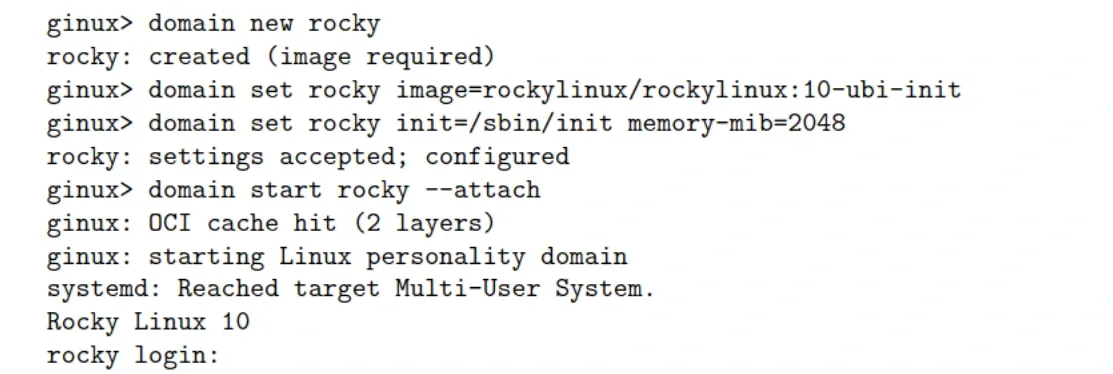
| Userspace boot | Can assemble roots from standard OCI images and boot Rocky Linux 10 to systemd multi-user.target | Strong proof of concept, still short of broad Linux distribution compatibility |
| Isolation design | Domains separate processes, address spaces, filesystems and lifecycle state | Potentially interesting security model, but audit evidence is not there yet |
| Hardware target | Runs in QEMU; no physical boot, GPU or NVMe support described in the project limits | Hardware enablement remains the major unknown |
The isolation model deserves separate attention. Ginux introduces "Domains" as execution environments where each domain has its own processes, memory space and filesystem. The project still uses standard OCI container images to build those domain roots, which makes the mechanism easier to evaluate for teams already working with container image pipelines. The difference is that execution and isolation are not delegated to a Linux kernel's container machinery; Ginux attempts to provide that boundary itself.
Human-directed agentic engineering changes the cost curve, not the trust curve
The development method is as important as the kernel demo. Kurtzer describes it as human-directed agentic engineering. He sets architecture, phases, constraints and acceptance criteria. The AI coding agent then performs much of the implementation loop: writing code, starting the kernel, running tests, diagnosing failures and revising. In practice, a continuous OpenAI Codex task powered by GPT-5.6 Sol produced approximately 139,000 lines of retained implementation and test content in 11 days, with 1000+ commits recorded during the process.
That workflow is documented beyond the social-media announcement. Kurtzer's technical report, "Ginux: Building an Independent Kernel That Runs Linux Userspace through Human-Directed Agentic Engineering", is available as a Zenodo record at zenodo.org/records/23682548. The report's value for open-source readers is not marketing polish; it exposes the method, the evaluation boundaries, and the places where the prototype remains incomplete.
One concrete operational detail from the repository is especially useful: the validated development target is QEMU's x86-64 Q35 machine with OVMF, Intel IOMMU and virtio devices, according to the project README on github.com/gmkurtzer/ginux. That narrows the demo. It is not a claim that the kernel runs everywhere a Linux guest would run. It says the current evidence is strongest in a specific virtualized environment, which should shape any pilot plan.
A safer case pattern: using Ginux as a syscall-gap laboratory
For data infrastructure, model-serving or container-platform teams, the practical case is not "replace Linux next quarter." The safer case is to treat Ginux as a diagnostic rig. A low-risk evaluation can clone the GitHub project, run it only inside QEMU, boot a Rocky Linux 10-based OCI root, then record every kernel interface used by a representative workload. The result should be mapped against the 375-call Linux 6.12 x86-64 reference and the current implementation split: 82 full, 245 partial, 48 absent.
This turns Ginux into an engineering instrument. If a data pipeline depends heavily on network stacks, complex process supervision, filesystem semantics, device passthrough, GPU access or NVMe-backed storage, the prototype is likely to show limits quickly. Those limits are more valuable than vague hype: they tell teams whether AI-generated systems code can be used for research, ABI experiments, teaching or early feasibility work, without pretending it is production infrastructure.
How it fits into the broader AI-systems trend
Ginux can be read beside other recent large-scale agentic coding experiments. Anthropic researcher Nicholas Carlini reported an earlier C compiler project that used 16 parallel Claude agents and produced roughly 100,000 lines of Rust code, with an estimated cost near $20,000. That comparison matters because it separates two different problems: a compiler has a comparatively stable test oracle, while an operating-system kernel must satisfy external Linux ABI behavior, device expectations, scheduler assumptions and userspace integration.
Media summaries of the Ginux experiment, including 36kr's report, place the API usage cost near $8,000 for the 11-day run. If that figure is read as a cost benchmark rather than a product metric, the trend is clearer: expert-defined acceptance loops may make very difficult systems experiments cheaper to attempt, but they do not remove the need for long-term maintenance, hardware enablement or security assurance.
Governance context: Linux is adopting AI tools without abandoning review
The kernel community itself is the most useful comparison point. Last month, Linus Torvalds used Claude Code to produce experimental page-cache patches, but reviewers later identified a race condition, leaving the work under continued scrutiny. Around the same time, Linux kernel maintainers moved away from requiring contributors to disclose whether code was AI-assisted. The governance signal is not "AI is now trusted by default." It is that generated code is being absorbed into the same review pipeline, with human responsibility still attached.
Kernel documentation also continues to emphasize review and developer responsibility when AI assistance is used; see the Linux kernel coding-assistant guidance at docs.kernel.org/process/coding-assistants.html. For open-source projects evaluating Ginux, the implication is practical: the Apache 2.0 license reduces legal friction for reuse, but it does not substitute for provenance review, test coverage, dependency audit or maintainer capacity.
Common misconceptions to avoid
- Equating "independent kernel written in Rust" with "complete Linux replacement." The project's own system-call map contradicts that leap.
- Assuming UEFI or QEMU success implies physical hardware readiness. GPU and NVMe support are absent, and physical boot is not established.
- Treating Rocky Linux 10 reaching systemd multi-user.target as proof that all distributions and applications will work. Booting one userspace milestone is not the same as broad ecosystem compatibility.
- Believing Apache 2.0 solves compliance risk. License terms are necessary, but not sufficient, for enterprise OS evaluation.
- Confusing AI-generated volume with reliability. A large codebase can still contain unsafe concurrency, incomplete drivers or missing security hardening.
Action checklist for engineering and compliance teams
- Use Ginux for research, ABI gap analysis and workflow experiments only; keep production workloads on maintained operating systems.
- Build a syscall dependency matrix for your own workloads before any test, then compare it against the Linux 6.12 x86-64 reference and the project's 82/245/48 implementation split.
- Restrict tests to QEMU and record which device features are missing, especially GPU and NVMe paths.
- Treat the Zenodo report and GitHub history as audit artifacts; monitor for independent review, reproducibility notes and community-reported bugs.
- If a BSD compatibility mode or stronger Domain isolation appears later, evaluate it through concrete security claims and reproducible tests, not through container marketing analogies.
Ginux is not a new Linux. It is a compact demonstration that a disciplined human-AI engineering loop can build a surprising amount of system software very quickly while still leaving the hardest questions untouched: compatibility, hardware trust, auditing, community support and long-term maintenance. For the open-source stack, the most durable value may be the public artifact itself: the repository, the report, the system-call inventory, the stated limits and the uncomfortable gap between a fast prototype and an operating system that enterprises can responsibly run.