
Hob on Mac, Windows, and Linux: What OpenSource Readers Should Check About the Alternative to Claude and ChatGPT

Open-source local AI tools are often judged by whether they reduce setup effort, keep data on the user's own machine, and provide a clear license and installation path. The Hob description at hob.chat is framed around those ideas: it presents the project as a free, open-source alternative to Claude and ChatGPT for AI on a personal computer, with downloads for Mac, Windows, and Linux.
Why the Hob claim matters for OpenSource teams
For developers, data scientists, and technical product managers, the phrase local AI tool is not enough. A reader needs to know what kind of software is offered, which systems it targets, how it chooses models, and what license controls reuse. The article gives short answers: Hob is made by Frigade, the MIT license is listed, and the tool is described as choosing the best frontier open-weight model that fits a computer and configuring the setup.
That matters because open-weight model selection is the technical heart of the claim. The value proposition is not only a chat interface, but a local configuration layer that attempts to match an available model to the user's hardware.
What the Hob listing states
- Hob is described as a free and open-source alternative to Claude and ChatGPT for use on a personal computer.
- Details are available at hob.chat, and downloads are listed for Mac, Windows, and Linux.
- Apple silicon Mac systems, Windows machines, and Linux machines with 8 GB of memory or more are mentioned as supported.
- Use cases mentioned include filling out PDFs, working through documents, and many other tasks.
- The offering is described as free, private, and able to work offline.
- The project is attributed to Frigade, and the MIT license is listed.
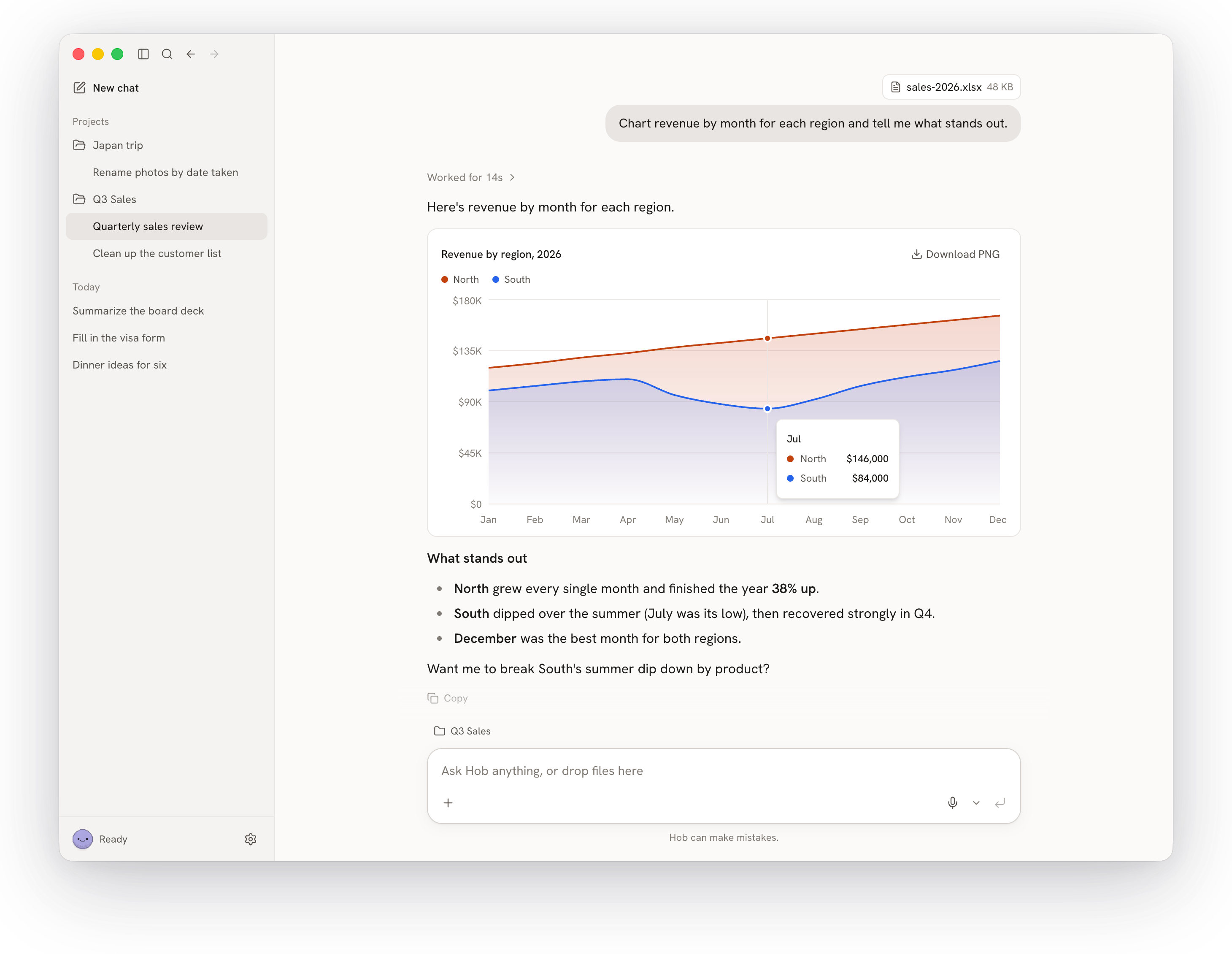
How to read the platform and memory line
The article does not provide a benchmark table, a model list, a version history, or enterprise support terms. Therefore, the safest way to evaluate the claim is to treat each statement as a verification task rather than as a finished engineering guarantee.
Hardware and system assumptions
When Hob is said to work on a personal computer, the supported targets include Apple silicon Mac systems, Windows machines, and Linux machines with 8 GB of memory or more. For an open-source evaluation, that line creates three questions:
- Does the local setup load and run on the specific Mac, Windows, or Linux image used by the team?
- Does the selected frontier open-weight model fit within the memory boundary named in the article?
- Does the described offline behavior hold during normal document tasks?
Licensing and attribution assumptions
The MIT license and Frigade attribution provide the starting point for legal and engineering review. Readers who redistribute, modify, or bundle the tool still need to preserve license text, notice obligations, and any dependency terms that are not described in the article.
Platform support comparison table
| Platform mentioned | What the article says | What to verify before local use | OpenSource risk check |
|---|---|---|---|
| Mac | Apple silicon Mac systems are mentioned as supported. | Installer behavior, permission prompts, and model-selection status on the user's Mac. | Whether the local runtime depends on undocumented Apple silicon assumptions. |
| Windows | Windows machines are mentioned as supported. | Release channel, executable signature workflow, and memory footprint on test hardware. | Whether Windows variants have different package or driver requirements. |
| Linux | Linux machines with 8 GB of memory or more are mentioned. | Package format, library compatibility, and offline execution on the chosen distribution. | Whether the stated memory line is a minimum, a recommendation, or a practical testing threshold. |
Deployment path suggested by the published description
- Start from hob.chat and record the download labels, release notes, license, and any version identifiers available at that time.
- Confirm that the target system falls under Mac, Windows, or Linux as stated, and that the hardware meets the 8 GB of memory or more line where relevant.
- Review the MIT license and the Frigade attribution before sharing the build inside an organization.
- Install on a non-sensitive test machine, then run the described tasks such as filling out PDFs and working through documents.
- Record whether the tool can operate offline, whether data remains local, and whether model selection behaves consistently when the hardware changes.
- Only then compare the local experience with the article's positioning as an alternative to Claude and ChatGPT.
Case: using Hob for document work
The article's clearest practical example is document handling: filling out PDFs, working through documents, and many other tasks. This gives a narrow but useful pilot. A team could test with a non-sensitive PDF form, a plain text file, and a short summary prompt, then log success rate, latency, memory usage, and whether the interface requests network access.
The point of the case is not to prove that Hob outperforms Claude or ChatGPT. The article does not provide comparative benchmarks. The case is a verification step: does the described local, private, offline workflow actually complete the document task without exceeding the hardware boundary?
Common misconceptions to avoid
- Assuming "alternative to Claude and ChatGPT" means the same service level, model catalog, or account workflow. The article only positions Hob as a free and open-source alternative for use on a personal computer.
- Assuming the MIT license replaces dependency review. The license is listed for the project, but local open-weight models and bundled components may require separate checks.
- Assuming "private" and "offline" are independently verified security claims. Treat them as described properties until the team observes data paths and network behavior during tests.
- Assuming the memory line applies identically to Mac, Windows, and Linux. The article mentions Apple silicon Mac systems, Windows, and Linux machines with 8 GB of memory or more; implementation details should be tested on each target.
Risk boundaries for engineers and compliance reviewers
The article gives enough information for a first technical screen, but not enough for an enterprise rollout decision. The risk boundary is narrow: Hob is positioned as a local tool, not a hosted replacement; the MIT license and Frigade attribution are stated, but redistribution terms, model provenance, and update policy are not described in detail. For compliance teams, the important question is whether the installation path from hob.chat and the local execution model can be reproduced, logged, and constrained to non-sensitive data during early testing.
For engineers, the risk boundary is also practical: the project claims to choose the best frontier open-weight model that fits the computer. That means model quality, compatibility, and failure modes may change when the hardware changes. A controlled test on Mac, Windows, and Linux is therefore more meaningful than a single successful installation.
Action advice for OpenSource readers
Read the Hob listing as an entry point, not as a complete technical specification. Start at hob.chat, verify that the download targets Mac, Windows, and Linux, and note the article's support wording around Apple silicon systems and 8 GB of memory or more. Check the MIT license and the Frigade attribution, then run a small pilot with PDF and document tasks. Record whether the tool behaves as a local alternative to Claude and ChatGPT in the way your workflow needs: usable, private enough for the data being tested, able to work offline where expected, and stable across the hardware you actually control.