
npu-driver Case Review: Rendering a Windows 11 Desktop on an Intel NPU Under Apache 2.0
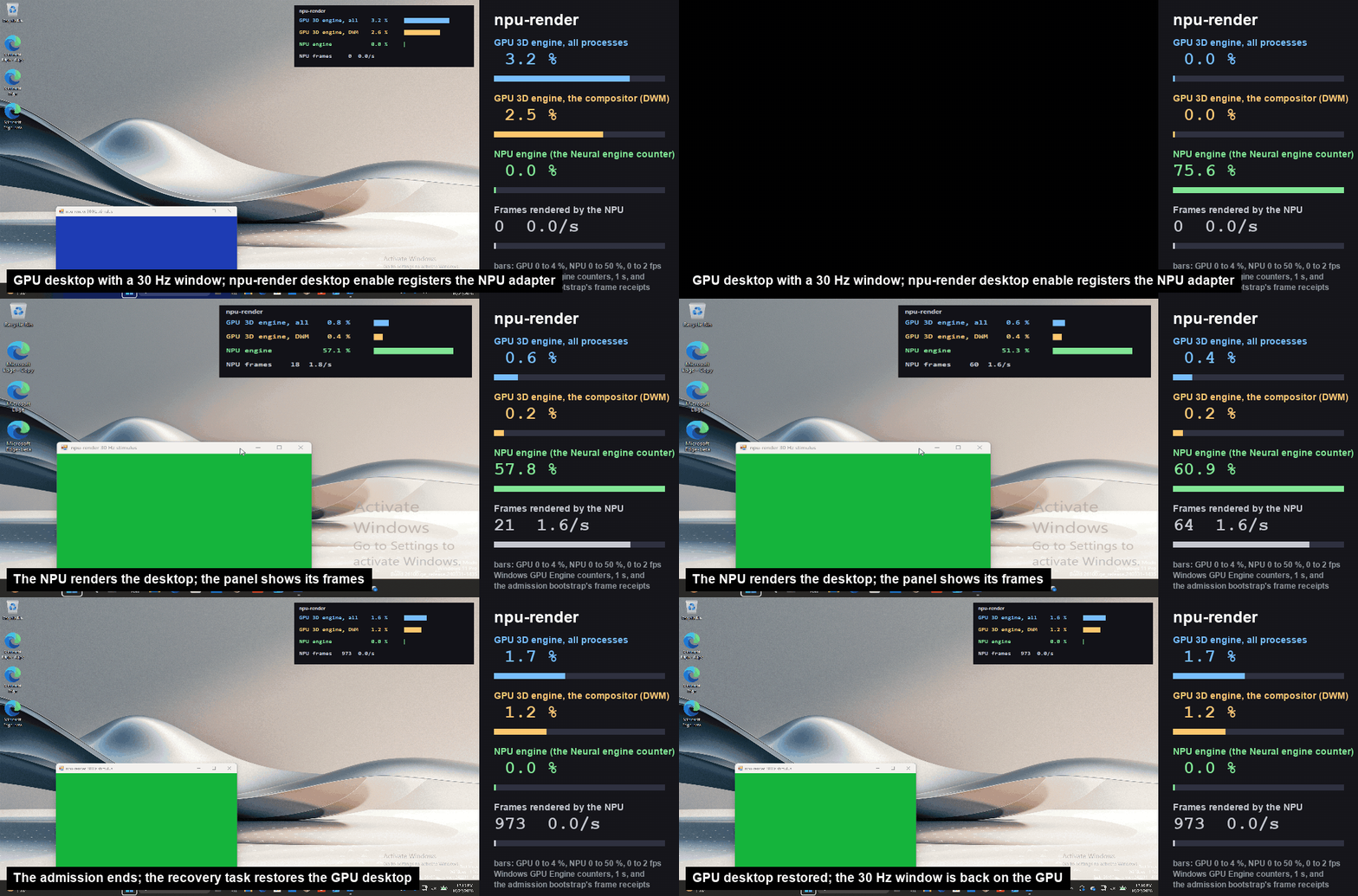
Short answer: the experiment works, but only as a proof of path. labscommunity's npu-driver, an Apache 2.0 research display driver published on GitHub, rerouted Windows 11 desktop composition away from the GPU and onto an Intel Panther Lake NPU, drawing Notepad, File Explorer and Microsoft Edge windows at 2 to 3 frames per second against the 60 frames per second or higher of an ordinary desktop. It is a hardware-scheduling test bench, not something to install.
AI & Data News · OpenSource desk | By David Nakamura · corrections: editorial@aidatanews.com
Because the source is public and small enough to read in one sitting, the release deserves a proper open-source review rather than another headline: it shows how much unused capacity sits inside a certified AI PC, and how many engineering steps stand between "the NPU can do it" and "the desktop is usable". The case below is reconstructed in the order it happened — objective, implementation, measured cost, deployment constraints — with licence terms and risk boundaries pulled apart from the marketing frame.
What did npu-driver actually change in the graphics path?
Conclusion first: nothing above the display driver changed, and everything below it did. The project captures the draw work that the Windows Desktop Window Manager (DWM) would normally send to a graphics card and re-executes it on the NPU.
Windows applications kept running the traditional way. Notepad, File Explorer, the Start menu, Microsoft Edge and other windows needed no adaptation for the NPU. The change happened in the low-level graphics processing path, where the desktop composition tasks previously carried out by the GPU were reassigned to the NPU. That distinction is the first thing to check in any evaluation: this is a compatibility-layer experiment, not an application-framework migration.
On the implementation side, the published design uses a custom Direct3D 10 user-mode driver. Graphics operations are recorded as frame batches, then passed through OpenVINO and dedicated SHAVE compute kernels to the Intel NPU. The team also wrote its own rasterisation module to handle vertex processing, texture sampling and layer blending — classic GPU chores that this silicon was never asked to perform. The project README states the research question in deliberately narrow terms: whether an NPU can take over desktop composition end to end without applications or the compositor noticing the change.
How did the case move from community post to press wave?
The build target was a single hardware class: a laptop using an Intel Panther Lake processor, whose fifth-generation NPU architecture delivers NPU throughput rated at 45 to 50 TOPS. Panther Lake ships under the Core Ultra Series 3 name; independent specification round-ups such as Notebookcheck's Panther Lake coverage put the top configurations at 50 TOPS on the NPU and roughly 180 TOPS of combined CPU, GPU and NPU platform throughput. Microsoft's own Copilot+ PC floor is an NPU able to run at 40+ TOPS (Microsoft Learn, "Develop AI applications for Copilot+ PCs"). The practical consequence for adopters: the machines that already clear the certification gate are exactly the machines this driver can target, so the addressable hardware base is growing rather than exotic.
The public trail is reconstructable. A developer associated with labscommunity presented the project on Reddit's r/LocalLLM board in late October 2026, framing the goal as finding out whether Windows 11 could be made to treat the NPU like a GPU and composite the desktop GUI with it. Press coverage then landed in a wave on 4 November 2026, including Tom's Hardware. The most quotable engineering number from that community post is not the frame rate at all: on the test machine, 3D GPU utilisation dropped from 3.4% to 0.6% — GPU work displaced, not accelerated.
Read as a case, that sequence is worth memorising for anyone tracking open-source AI hardware. The project surfaced first in a practitioner community carrying the favourable metric (freed GPU headroom), and reached general tech media carrying the unfavourable one (2 to 3 frames per second). Both measurements are genuine; they answer different hypotheses, and the second does not invalidate the first.
Why does the desktop crawl at 2 to 3 frames per second?
Conclusion: the frame rate is not a tuning bug, it is the physical price of emulating a rasterisation pipeline on a machine built for matrix arithmetic. The gap to daily use is therefore measured in orders of magnitude, not in optimisation passes.
| Rendering path | Measured refresh | How to read it |
|---|---|---|
| Ordinary Windows desktop | 60 frames per second or higher | The baseline any user perceives as fluid. |
| npu-driver current tests | 2 to 3 frames per second; some runs as low as 0.6 frames | Slideshow territory: moving a window, opening File Explorer or touching the task bar becomes visibly sluggish. |
| Developer target | 30 frames per second | Stated goal; still a wide gap from current measurements. |
What sits inside the NPU explains the shortfall. Intel's NPU blocks pair a fixed-function multiply-accumulate array with a small number of SHAVE programmable vector DSPs — SHAVE stands for Streaming Hybrid Architecture Vector Engine, inherited from the Movidius VPU lineage (Chips and Cheese, "Intel Meteor Lake's NPU"). There is no dedicated texture unit, no fill-rate pipeline, no rasteriser hardware; those tasks run as code on general-purpose vector engines. Two further frictions are my analysis rather than published measurement: every frame must be re-expressed as a batch the OpenVINO NPU compiler will accept, and the NPU plugin expects static tensor shapes (docs.openvino.ai, "Configurations for Intel NPU with OpenVINO"), whereas a real desktop emits irregularly sized and irregularly frequent updates.
So the experiment proves that the NPU can carry complete desktop composition work, while falling far short of the performance daily use demands. Lifting refresh speed toward 30 frames per second would require reworking how draw batches are formed and executed, not merely raising clocks.
Is this really the first GPU-free Windows desktop?
No, and adopters should say so precisely. Windows already renders without a GPU — on the CPU, which is exactly what npu-driver avoided. The in-box Microsoft Basic Display Driver (BasicDisplay) is paired with BasicRender, the system module that exposes WARP, Windows' software rasteriser, in safe mode, during graphics-driver transitions, and on display-only adapters with no render-capable driver installed (Microsoft Learn, "Microsoft Basic Display Driver" and "Windows Advanced Rasterization Platform (WARP) Guide").
The genuine novelty is narrower and harder: the same class of work was moved onto a different compute block inside the processor, without touching applications or the compositor, and with a working fallback path. That is the claim worth citing in internal reviews.
Can your team build or deploy it today?
Conclusion: not as anything resembling production use, and not on a managed fleet without weakening the boot trust chain. Treat it as a lab exercise with a defined prerequisite list.
- Hardware floor: an Intel Panther Lake laptop with the fifth-generation NPU rated at 45 to 50 TOPS; current development sits on a single Panther Lake notebook, so reproducibility outside that device is unproven.
- Toolchain dependencies: a compatible Intel NPU driver, the OpenVINO runtime and additional development tools. Ordinary users cannot simply install the package and receive a GPU-free Windows 11 system.
- Driver trust chain: a custom display driver is kernel-mode code. Windows 11 x64 permits locally test-signed drivers only with Secure Boot switched off, and Hypervisor-protected Code Integrity (HVCI) rejects custom kernel signers (Microsoft Learn, "Loading Test Signed Code"; OSR community discussion of driver development on Windows 11). On Windows on ARM, locally signed drivers are not supported. Disabling Secure Boot and HVCI to accommodate a research driver breaches Secured-core compliance baselines.
- Rollback behaviour: an automatic fallback reassigns rendering to the integrated or discrete graphics card when the NPU driver errors out or the user requests the switch. The limitation is documented in testing: some runs could not fully restore the positions of all application windows.
- Project maturity: developers describe npu-driver strictly as a research prototype, not a mature consumer product.
| Due-diligence dimension | What npu-driver provides | Adoption implication |
|---|---|---|
| Licence | Apache 2.0, source public on GitHub | Commercially usable and modifiable, but with no warranty. |
| Reproducibility | One Panther Lake reference laptop | Assume zero cross-vendor, cross-SKU coverage. |
| Performance headroom | 2 to 3 frames per second against a 30 frames per second goal | No interactive use case qualifies today. |
| Fault containment | Automatic GPU fallback with recovery gaps | Acceptable on a lab bench, not on a managed endpoint. |
| Support surface | Community repository, no vendor SLA | Any derivative becomes your maintenance burden. |
What does the Apache 2.0 licence allow, and what does it not?
Conclusion: the licence is the least restrictive part of this story; the absence of warranty is the most binding.
- Apache 2.0 permits commercial use, modification, distribution, private use and patent use, provided the licence text and any NOTICE file travel with redistributed or derivative works, and modified files carry notices of change (Apache Software Foundation, "Apache License, Version 2.0").
- It grants a conditional patent licence from contributors, which is the clause that makes the code attractive for internal prototyping inside product organisations relative to more restrictive research licences.
- It confers no trademark rights for the labscommunity name, and it explicitly provides the software "as is", without warranty or liability. A forked display driver shipped in a device transfers all reliability risk to the integrator.
- For compliance registers: an unsigned kernel-mode display driver built from this tree is not a distributable artefact on secured Windows 11 endpoints without an attestation or WHQL-style signing path, independent of what the licence permits.
Five misconceptions this case keeps generating
- "It proves NPUs can replace GPUs." It does not. The developers' own framing is that the point is redistributing work among the different compute units inside a modern processor, not substituting one unit for another.
- "It is the first Windows desktop with no GPU." Windows has long run WARP and BasicRender on machines without a render-capable driver; the contribution here is routing that work to the NPU unchanged at the application layer.
- "Apache 2.0 means we can ship it." The licence permits it; the reliability posture, the signing chain and the 2 to 3 frames per second measurement do not.
- "Any AI PC can run it." Testing rests on Intel Panther Lake hardware with the fifth-generation NPU at 45 to 50 TOPS plus compatible drivers and extra tooling.
- "Slideshow frame rate means the approach is worthless." The displacement of 3D GPU utilisation from 3.4% to 0.6% is the finding that matters for heterogeneous-scheduling research; the frame rate is the cost of acquiring it.
Action recommendations by role
- AI engineers: fork the tree only to study the draw-capture to OpenVINO conversion. Your reusable artefact is the rasterisation module written in SHAVE-targeted kernels, which is a template for mapping non-NN pipelines onto NPUs.
- Data and platform teams: use the 40 TOPS Copilot+ floor and the 45 to 50 TOPS Panther Lake figures as a procurement filter. Idle NPUs are real capacity; benchmark what your stack actually leaves unallocated before assuming it is unusable.
- Compliance and endpoint operations: record test signing, Secure Boot disablement and HVCI off as explicit deviations with expiry dates. Do not evaluate this project on production images.
- Technical product managers: track the 30 frames per second milestone as the single gate that changes the business case. Below it, this is a research curiosity; near it, GPU headroom reclaimed on the same die becomes a feature you can price.
- Researchers: the interesting open question is not frame rate but task semantics — which composition operations degrade gracefully when expressed as matrix and vector workloads with static shapes.
FAQ
Can I install npu-driver to free up my GPU for local AI models?
No. It requires specific Intel Panther Lake hardware, a compatible NPU driver and additional development tools, and it renders the desktop at 2 to 3 frames per second, with some tests as low as 0.6 frames. The GPU utilisation drop from 3.4% to 0.6% was measured on a single research laptop, not offered as a performance feature.
If the desktop still works, why is the frame rate so low?
Because every rasterisation stage — vertex processing, texture sampling, layer blending — is executed as code on SHAVE vector DSPs instead of fixed-function graphics hardware, and each frame must be re-shaped into batches the OpenVINO NPU path accepts. The NPU is optimised for matrix operations and neural-network inference, not for the fill-rate pattern of a compositor.
Does the automatic fallback make it safe to try?
It limits the blast radius but does not remove it. When the NPU driver errors or the user requests a switch, rendering returns to the integrated or discrete graphics card; in some tests, however, the recovery could not fully restore the positions of all application windows. The signing prerequisites are the larger problem, since they require relaxing Secure Boot and HVCI protections.
What would make this project worth re-evaluating?
Three verifiable signals: the reported refresh rate approaching the 30 frames per second target, the tested hardware base widening beyond one Panther Lake laptop, and reproducibility steps in the repository that work on a second device.
Why this belongs in the open-source record anyway
The experiment does not show that the NPU can supersede the graphics card. CPU, GPU and NPU pursue different design goals: GPUs excel at large-scale parallel graphics computation, while NPUs are optimised for matrix operations and neural-network inference. Making an NPU perform desktop rendering forces engineers to translate a conventional graphics pipeline into work suited to neural compute units, which is why the engineering complexity is high. If processing efficiency improves substantially, the NPU could take on some lightweight desktop tasks the GPU currently owns, releasing GPU resources for gaming, video processing or local AI inference. For now, npu-driver stands as a clean, falsifiable demonstration that Windows 11 desktop composition is not the exclusive property of a traditional GPU — bought at a performance cost that is, at this stage, prohibitive.
Reference sources
- labscommunity project repository on GitHub: github.com/labscommunity/npu-render
- Tom's Hardware coverage of the npu-driver release, 4 November 2026: tomshardware.com
- Microsoft Learn, Copilot+ PC NPU requirements (40+ TOPS): learn.microsoft.com/windows/ai/npu-devices
- Microsoft Learn, Loading Test Signed Code: learn.microsoft.com
- Microsoft Learn, Microsoft Basic Display Driver and WARP guide: learn.microsoft.com
- OpenVINO documentation, Configurations for Intel NPU: docs.openvino.ai
- Chips and Cheese on Intel NPU internals (SHAVE DSPs): chipsandcheese.com
- Notebookcheck, Intel Core Ultra Series 3 (Panther Lake) specifications: notebookcheck.net
- Apache License, Version 2.0: apache.org/licenses/LICENSE-2.0