
AIdataNewsGlobal AIApplications Compared: AI-REAL's Host-less Sales Show vs. a Studio Shoot — Cost, Proof and the Missing Approval Gate
Deciding to drop the camera crew from a sales program is a production-architecture choice, not a creative one. A host-less broadcast can replace a studio shoot for the mechanical work of explaining a product, but not for the two claims that decide whether it should: where the 80% saving actually lands, and who signs off on imagery that reads as product evidence. That is the tradeoff Hyundai Home Shopping put on air with AI-REAL.
The decision was announced on November 15. In system terms, the team moved the burden from physically capturing a scene to describing, then verifying one — a swap that cuts logistics cost while pushing risk upstream into the approval layer. For a practical AIApplications reader, that is the part worth watching: which tasks became cheaper, and which judgement calls stayed human.
What changes when the whole program — not just the host — is generated?
Conclusion: the constraint shifts from cameras and studios to verification. AI-REAL generates voice and video together, so there is no live on-screen presenter and no camera shoot to schedule.
The system runs on Hyundai Home Shopping's data shopping channel, PLUS#, also called Plus Shop. The first regular program sells Jeju Heart Gold kiwis on November 16 at 3:20 p.m. in South Korea, or 1:20 p.m. WIB. Hyundai Home Shopping presents this as a step beyond using AI for a single host or a handful of selected scenes.
Food is the working case. Growing conditions, soil and distribution processes are costly to stage in a conventional studio. Generated visuals can describe those details without a second location shoot or physical props — the economy is in capture, not in the underlying product facts.
The still supplied by Hyundai Home Shopping shows an AI-REAL trial broadcast with generated visuals and a virtual presenter. It documents the format; it does not show a real on-screen host.
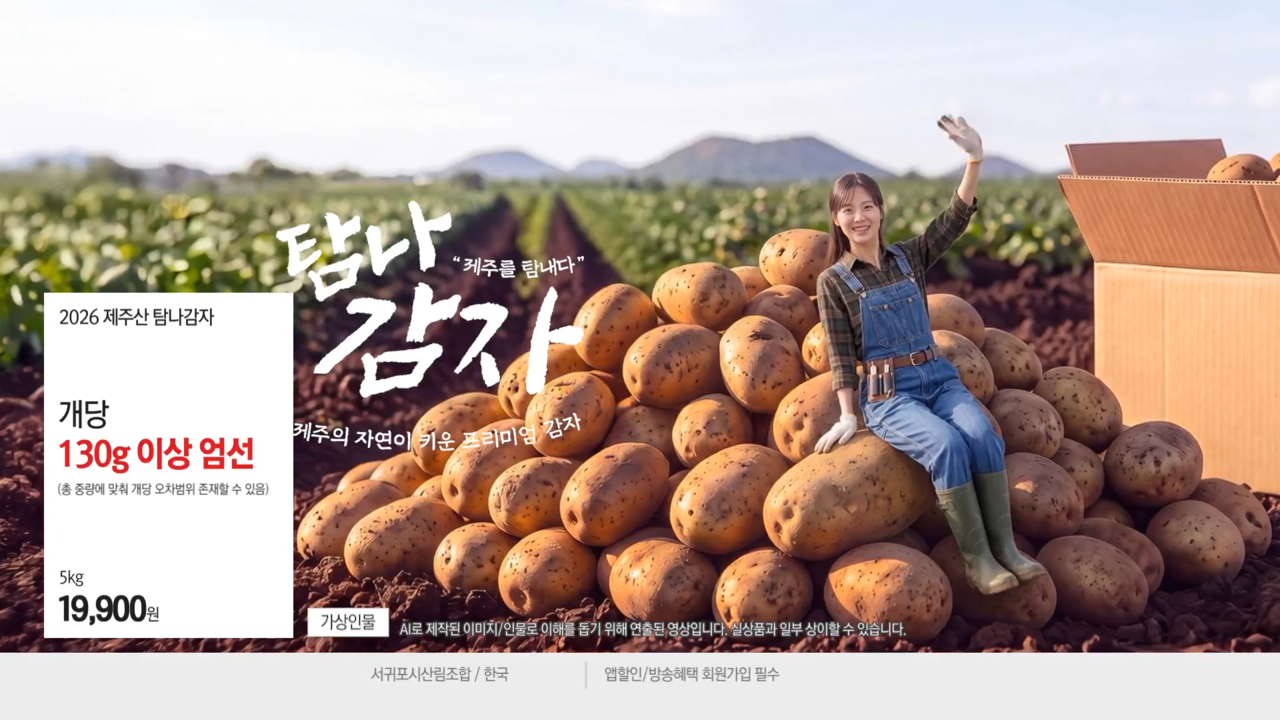
Lim Soo-jin, head of broadcast production at Hyundai Home Shopping, said viewer feedback indicated that "information such as growing conditions and cooking examples helped them decide whether to buy." Read carefully, that is company-reported feedback on intent, not an independent conversion result. The distinction matters as soon as a generated depiction starts to look like product evidence.
Where does the 80% saving land, and is 120% a real lift?
Conclusion: the 80% is a narrow supplier-preparation figure, and 120% is target attainment — neither is a full-budget saving nor a causal lift.
In a trial, expenses for sample preparation, supplementary video production and related work fell by at least 80%, according to Hyundai Home Shopping. That boundary is precise: it covers participating suppliers' preparation, not the retailer's total production budget. The announcement gives no breakdown of software charges, internal labor, review time, or the cost of correcting generated material.
Sales reached 120% of the target — a company-reported measure of trial target attainment, not a 120% increase in sales. Beating a target says nothing about the incremental effect of AI without a comparable conventional program matched on product, price, audience and airtime. The trial sample size was not disclosed.
A system view clarifies the gap. BCG's 10-20-70 rule puts roughly 10% of AI value in algorithms, 20% in technology and data, and 70% in people and processes. The 80% figure sits almost entirely in the capture slice; the 70% — review, correction, approval, role design — is exactly what the announcement never quantifies. Treating 80% as a whole-production saving conflates one line item with the system.
Lower cost in a demonstration and greater effectiveness in a demonstration are two different results, and this trial establishes neither at full-program level.
Illustration vs evidence: why a shopping demo faces a different proof bar than an AI ad
Conclusion: the same generation tool is judged by different standards depending on whether its output is a creative device or a product claim.
AI-built advertising often draws attention by depicting something improbable. Fresh Step's talking-cat films are a recent example. Hyundai AI-REAL is assigned a different job: explain a product in enough detail to support a purchase decision inside a sales program.
| Example | Creative task | What it establishes |
|---|---|---|
| Fresh Step talking-cat ads | Use generated characters to make a benefit memorable | A brand-specific advertising production method |
| Hyundai AI-REAL | Generate a full sales presentation and illustrate product information | A retailer-specific broadcast production method |
They are distinct formats with no shared cost benchmark. In a comic ad, an impossible character reads as a device; in a shopping demo, an image of growing conditions may read as proof. The more realistic the explanation looks, the harder it is to separate verified information from illustrative reconstruction. Producing the scene is not the same as verifying the claim.
External evidence cuts both ways. NYU Stern's AI Advertising Paradox study reported that visual GenAI-created ads outperformed both human and AI-modified benchmarks, while a Tilburg University study found a small but statistically significant homogenization effect from generative AI (d = .334). The practical read for an AIApplications team is not "AI wins" — it is that cheap volume raises the value of a human screening step rather than removing it.
How do you embed this in a workflow, and what disclosure comes with a virtual presenter?
Conclusion: the reproducible unit is the workflow and its gates; the virtual presenter adds a disclosure duty the announcement never addresses.
- Scope the saving before briefing anyone: capture, review, correction and deployment as separate lines.
- Draft the product explanation, then tag every visual as verified fact or illustration.
- Run a blind brand-recall check on the generated presenter and script.
- Assign a named human approver per program, with an explicit trip condition: matches the product and is labelled.
- Air one pilot slot, collect decision-quality feedback, then set cadence.
Hyundai says it will begin with agricultural products, meat and seafood, then expand toward processed foods and household goods. Korea Bizwire reports a plan to schedule AI-generated programs at least once a month. That cadence is the real constraint: a monthly slot is a pilot loop, not a schedule replacement — enough space to inspect each program before it airs.
The announcement does not reveal the human approval process, nor does it establish that other retailers can buy AI-REAL as a commercial software service. The transferable unit is therefore the method, not the product. We have examined the same shape of problem through licensed AI likeness workflows, where the value sits in keeping approval inside the pipeline — different asset, identical governance question.
A virtual presenter also carries a labelling duty that a plain product visual does not. New York's synthetic performer disclosure law took effect on June 9, 2026, requiring conspicuous disclosure when an ad includes a synthetic performer, with a $1,000 civil penalty for a first violation and $5,000 for later ones. Hyundai's stated market here is South Korea, but any team reusing the format across borders should build disclosure into the workflow. For automations that touch real customers unsupervised, the design question is what signal trips the circuit breaker; here the gate is whether the depiction matches the product and carries a label.
FAQ
Is the 80% cost cut a full production saving?
No. It covers specified supplier preparation costs — sample prep and supplementary video — not software, internal labor, review, correction or the total budget.
Did the AI-REAL trial prove sales rose 120%?
No. Sales reached 120% of the target, which is target attainment, not a 120% increase. No comparable conventional program or sample size was disclosed.
Can another retailer buy AI-REAL?
The announcement does not establish that. It describes an internal system for Hyundai Home Shopping's PLUS# / Plus Shop channel, not a commercial software product.
Does a virtual presenter need a disclosure label?
Depending on jurisdiction, yes. New York's law effective June 9, 2026 requires conspicuous disclosure of synthetic performers in ads. Teams should build the label into the workflow rather than bolt it on.
Common misconceptions before you copy it
- "80% cheaper" means the whole show is 80% cheaper — no, it is supplier preparation only.
- "120% of target" means a 120% sales lift — no, it is attainment against a target.
- A realistic image is a verified fact — no, it is a reconstruction until substantiated.
- Cheap generation removes the need for review — it increases it.
Decision checklist: should your team copy this pattern?
- Do you have a baseline covering generation, review, corrections and deployment?
- Is every product visual labelled as illustration or verified evidence?
- Is there a named approver and a trip condition for each program?
- Have you checked disclosure rules for every market the program runs in?
- Can you name the decision the pilot should improve — and measure it?
If the checklist has a blank, keep the studio shoot for that item. A generated program is a cheaper way to explain a product; it is not yet a cheaper way to stand behind the explanation. The teams that get this right will spend less on capture and more on the discipline of tying each persuasive detail to something the seller can substantiate.
Reference sources
- BCG — The Leader's Guide to Transforming with AI (10-20-70): https://www.bcg.com/featured-insights/the-leaders-guide-to-transforming-with-ai
- Reuters — New York AI-generated performer disclosure legislation: https://www.reuters.com/legal/legalindustry/new-york-legislation-requires-disclosure-ai-generated-performers-advertising--pracin-2026-02-05/
- NYU Stern — The AI Advertising Paradox: https://www.stern.nyu.edu/experience-stern/faculty-research/ai-advertising-paradox
- Tilburg University — Generative AI Makes Creative Output More Homogeneous: https://research.tilburguniversity.edu/en/publications/generative-ai-makes-creative-output-more-homogeneous/
- Korea Bizwire — Hyundai Home Shopping launch details: http://koreabizwire.com/no-hosts-no-cameras-hyundai-home-shopping-launches-ai-generated-broadcasts/363313
- Korea Herald — AI-REAL announcement: https://www.koreaherald.com/article/10937399