
AIdataNewsGlobal Case File: Inside the DeepX DX-M2 Tape-Out and the 6.7× LPDDR5x-PIM Bet Under 5 W
Case in brief: The programme being taken apart here belongs to DeepX, a South Korean edge AI chip startup that has just taped out DX-M2 and is betting on a custom memory part — Samsung’s LPDDR5x-PIM — rather than on a bigger NPU. Simulations claim 6.7× more tokens per second on Llama3.1-8B and inference for models up to 100 billion parameters under 5 W. What follows covers the starting condition, the process, the evidence, the results and the reusable lessons.
Starting condition: what DX-M1 proves before DX-M2 begins
DeepX’s first-generation chip, DX-M1, is already in mass production for vision applications, and its published spec sheet sets the yardstick: 25 TOPS of INT8 compute in an M.2 2280 module drawing roughly 2 W to 5 W, today stocked by broadline distributors such as DigiKey. With DX-M2 freshly taped out, the pitch changes shape. The goal is to make local AI a practical option for devices with tight power and thermal budgets by executing models with 20 billion to 100 billion parameters (approximately 3 billion to 20 billion active parameters) at 10 to 30 tokens per second, depending on the model, inside the same 5 W power budget as the M1.
“The most important change [between M1 and M2] is the memory bandwidth,” DeepX founder and CEO Lokwon Kim told EE Times.
Memory bandwidth triples from 50 to 150 GB/s. DeepX credits two further multipliers stacked on top of it: design improvements that doubled the NPU’s power efficiency, and a 2-nm process node that doubled it again, allowing 80 TOPS. Measured against the first-generation module, that is close to a 3.2× step in peak compute delivered without touching the power ceiling — evidence that this programme is an efficiency play, not a raw-throughput play.
“This is important because with 5 W power consumption we can go everywhere, drones or any other battery-powered device,” Kim said. “Our goal is to enable deployment of sophisticated AI in all devices.”
The M2 also handles large mixture-of-experts LLMs, and it supports newer decoding tricks such as speculative decoding and TurboQuant.
 DeepX’s Tim Park (left) and Lokwon Kim (Source: DeepX)
Process: eighteen months of memory co-design before the headline number existed
In inference work the wall is usually traffic, not arithmetic. Weights have to cross between memory and compute constantly, and that is what constrains most types of AI inference operations — GEMV (general matrix-vector multiplication) most of all, where random memory accesses slow computation. PIM schemes from memory makers move those memory-bound operations inside the memory chip itself, so effective memory bandwidth rises and time-consuming access times shrink.
PIM is set to be covered by a JEDEC standard for LPDDR6. In the interim, DeepX has worked with Samsung to integrate the DX-M2 with Samsung’s custom LPDDR5x-PIM. The standards clock is not cosmetic: JEDEC previewed its LPDDR6 roadmap in April 2026 and described LPDDR6 PIM, which cuts data movement between memory and compute to raise inference performance at lower power, as nearing completion — the path DeepX says its third generation will take.
“We have spent one and a half years on this technology, collaborating with Samsung Memory, as they already have their custom PIM for LPDDR5x,” Kim said. “We already received LPDDR5x PIM samples and we are testing the operations and performance in-house.”
DeepX puts the payoff at 6.7× the tokens per second for Llama3.1-8B when GEMV operations are offloaded from the DX-M2 into LPDDR5x-PIM, compared with the DX-M2 alone.
Two outside data points calibrate that claim. At Hot Chips 2026 in August 2026, Samsung presented a silicon-validated version of the same memory: a device that behaves like a normal LPDDR5x part with 16 banks but places a small compute block at each bank, exposing roughly eight times the internal bank-level bandwidth a host controller normally sees. Samsung’s own measurement on Llama3.1-8B showed 3.01× higher tokens per second and a 2.28× shorter model run time, with runtime falling from 12.3 seconds to 5.4 seconds. A separate academic cycle-accurate modelling study, LP5X-PIM Sim, reported up to 6.2× acceleration on GEMV kernels. DeepX’s number is therefore credible as a system-level simulation outcome, but it sits at a different measurement layer from Samsung’s silicon demo — a distinction procurement teams should insist on whenever vendor multipliers are quoted.
| Claim on record | Figure | Measurement layer |
|---|---|---|
| DeepX: DX-M2 plus LPDDR5x-PIM, Llama3.1-8B | 6.7× tokens per second | Company simulation |
| Samsung: LPDDR5x-PIM silicon validation, Hot Chips 2026 | 3.01× tokens per second; 2.28× shorter run time | Device-level silicon |
| LP5X-PIM Sim academic study | Up to 6.2× on GEMV | Cycle-accurate simulator |
| DeepX: cost of the maximum-throughput mode | 2.7× system power; 2× gain inside the same envelope | Company simulation |
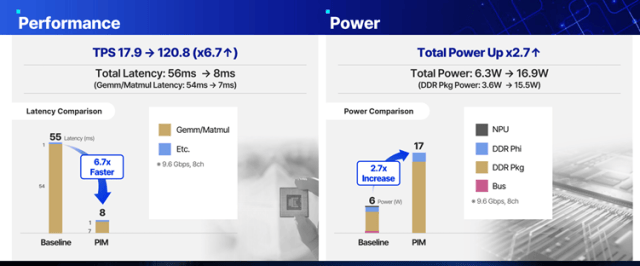 Offloading GEMV operations into memory will improve tokens per second by 6.7× (based on Llama3.1-8B), according to DeepX, at the expense of power consumption. (Source: DeepX)
“DX-M2 with LPDDR5x-PIM is close to optimal,” Kim said. “But our next generation, the DX-M3, will support official LPDDR6 PIM technology; then we can get the full theoretical performance advancement, which is 5× to 8× higher performance.”
The trade-off, Kim explained, is that extra compute doesn’t come for free: hitting 6.7× requires 2.7× the power consumption overall. What DeepX actually expects to ship is a 2× performance uplift within the same power envelope as non-PIM operation.
The least visible cost sits in tooling. Kim said “Substantial manual effort” is required in the compiler to support this mode of operation, and noted that DeepX currently has a prototype compiler running against a simulation of the PIM-enabled LPDDR5x. “We are now making the hardware modules so that we can test that in the physical environment, so we couldn’t finish the compiler yet, but we are actively working on it.”
Cases in the field: which programmes turned the spec into design work
Tim Park, director of strategic marketing at DeepX, maps the DX-M2 onto several key sectors. On the PC side the company is working with Taiwanese OEMs to find the right sweet spot for AI PCs, including laptops and workstations. Robotics companies currently prototyping on GPUs such as Nvidia Thor want lower power and more compute on-device, while automotive companies are looking for a low-power chip that can run agents in-vehicle, he told EE Times. Nvidia’s product page puts its Jetson Thor family at 2,070 FP4 TFLOPS inside a 40 W to 130 W envelope, which is exactly the friction Park describes: the platform is strong enough to prototype a humanoid, but that bracket is hard to reconcile with a mobile robot whose battery budget is measured in tens of watts. The GPU-class route is documented in our own case set on edge AI inference systems built on Jetson Thor modules.
Connectivity tells the same story. DeepX is already working with Samsung on a next-generation smart hub for IoT devices, and it is joining the AWS IoT ecosystem, where Greengrass would carry remote model updates out to deployed fleets.
In Park’s telling, robotics programmes almost always begin on GPUs and then must look for alternatives once thermal and power consumption realities bite. That is why DeepX is working hard to enable transitions from the Nvidia Isaac robotics platform to its in-house equivalent, Newton.
“Robotics customers ask us about our hardware, but also about how they can migrate from Nvidia to DeepX,” he said. “This is the answer—customers change their APIs to call Newton instead of Isaac and then they can run the exact same pipeline on the DeepX system.”
Park said DeepX has 17 compatible libraries up and running; the company has demonstrated M1-based robots using the same source code as an Nvidia Jetson-based robot, but calling the DeepX libraries instead.
“The actual outcome for the customer is they can enjoy 20 times longer battery life and [lower cost] when they switch from Nvidia to DeepX,” Kim said. “At the same time, the switching time can be under a second. They just need to change the API name from Isaac to Newton. That’s it.”
A full robotics stack for its hardware is under development and ships under the name DX-Newton.
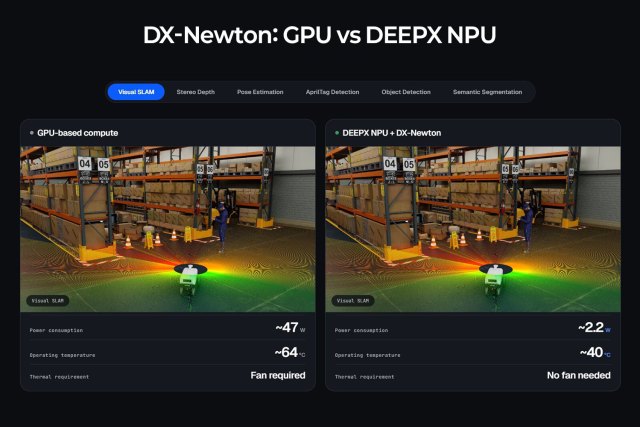 DeepX has developed software libraries for robotics under the name DX-Newton. (Source: DeepX)
Named adopters anchor the claim. Engagements run across the U.S., China, Vietnam and Korea, and Hyundai Motor Group Robotics Lab already uses the DX-M1 in its robotics platform.
The distribution strategy is ecosystem breadth rather than host-processor replacement. DeepX has been adding Taiwanese OEMs and vertical champions, and lately a collaboration with Intel: to reach Intel’s x86 installed base, it is integrating OpenVINO with the DeepX SDK, positioning the DX-M1 either as a complement to the NPUs built into Intel Core Ultra CPUs or as the AI engine for older edge CPUs that ship without one.
Kim said the company recently met with AMD about jointly developing a robotics platform pairing DeepX accelerators with AMD’s Kria reference board, aimed in particular at the Korean ecosystem. Similar work reaches other heterogeneous camps, among them Raspberry Pi and Baidu’s PaddlePaddle ecosystem.
One further case has moved from agreement to schedule. In June 2026, at COMPUTEX Taipei, DeepX and AAEON announced a three-year global mass-production partnership covering DeepX NPUs inside AAEON industrial computers, single-board computers and edge gateways — the kind of OEM volume channel DX-M1 previously lacked.
Results on the books: order book, market mix and the shift toward Japan
Order intake is the hardest evidence so far. Kim said DeepX has more than 100 purchase orders for the DX-M1, spanning all major global markets and all physical AI industries — drones, robots, smart factory, surveillance camera, aerospace and defense, healthcare, and IoT — with the M1 now in mass production.
The most active physical-AI market was previously China, Kim said; Japan has emerged this year as a major one, driven by willingness to pioneer humanoid robots.
“All the large Japanese companies are evaluating our chips, more than 10 leading companies in Japan right now, and their feedback is very encouraging,” he said. “At the same time, the U.S. market [is strong]; we have several big names there, and their feedback is really good.”
DeepX also appears in smart city programmes in South Korea, Vietnam and Singapore.
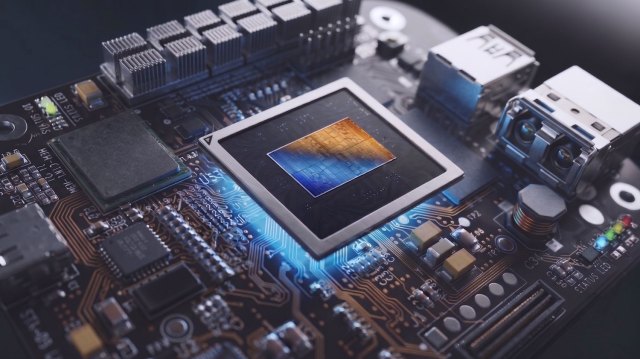 An artist’s rendering of the final DX-M2 chip, which has just taped out. (Source: DeepX)
Read-across: does edge inference really relieve the data center bill?
“Our long-term view is that AI compute will become more distributed as efficiency improves,” Park said. “The PC and smartphone eras showed how computing can spread into many products. AI will follow its own path, but local inference has clear value when an application needs immediate access to sensor data or operation without continuous connectivity.”
DeepX regards edge AI as a substantial opportunity for its chips, Park said, particularly at a time when the amount of power available for new data centers is limited. Kim’s analogy is market structure: just as only a quarter of the CPU market is in the data center today, he expects the AI processor market to shift to the edge in the next five to 10 years. With many AI data center projects delayed, his view is that the capacity issue can’t be solved with investment alone, and that AI chips consuming just 5 W allow models to migrate onto the device.
“If we deploy models up to 100 billion parameters in devices, we can reduce AI data center traffic by more than 80%,” Kim said. “That means we could have five times larger infrastructure without adding any AI servers. This is our vision.”
Two caveats belong in any assessment of that vision. First, the pressure it answers is documented: the IEA projects global data-centre electricity consumption rising from roughly 485 TWh in 2025 to about 945 TWh by 2030 — still just under 3% of world demand, but with grid interconnection queues, rather than capital, slowing many projects. Second, shifting inference to devices moves traffic, not the entire bill: training, evaluation and model updates stay centralised, and the arithmetic only holds if models up to 100 billion parameters truly fit inside memory and power envelopes that edge hardware reaches in 2027. The wider trade-off is the subject of our standing report on where AI inference runs, client silicon versus cloud data centers.
Next milestones and the risks a buyer should price in
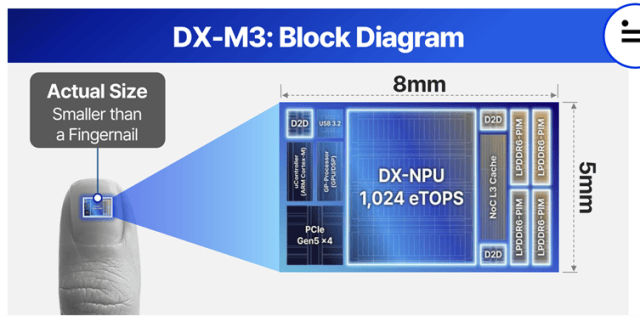 DeepX’s third-generation will be chiplet-based. (Source: DeepX)
The third-generation roadmap points to the DX-M3, coming in 2028: a chiplet-based design targeting 1 ePOPS (INT8) with LPDDR6-PIM, aimed mainly at automotive OEMs and humanoid robotics companies whose demands require multi-chiplet configurations. Between now and then, samples of the M2 are expected in March 2027, with mass production targeted for fall 2027.
- Simulation versus silicon. The 6.7× figure is a DeepX simulation; first physical samples arrive only in March 2027, so it should be read as a design target.
- Tooling debt. A prototype compiler built on a PIM simulation, plus “Substantial manual effort”, is the rate-limiting step for real deployments.
- Single-source memory. The custom LPDDR5x part comes from one supplier today: Korean trade press reported in June 2026 that DeepX regards Samsung as the only vendor of LPDDR5x-PIM, a supply-concentration risk attached to a sub-$50 price target for DX-M2.
- Power accounting. The maximum-throughput mode costs 2.7× overall power, so battery-life claims must state which mode they assume.
- Standards timing. The leap to 5× to 8× depends on LPDDR6 PIM being finalised, which JEDEC still describes as nearing completion.
Case-file FAQ
Is the 6.7× improvement a measured result?
No. It comes from DeepX simulations of DX-M2 combined with LPDDR5x-PIM running Llama3.1-8B, measured against the DX-M2 alone. Samsung’s silicon-validated Hot Chips 2026 demonstration reported a smaller but hardware-measured 3.01× tokens-per-second gain, which is the more conservative reference point until samples exist.
Why does processing-in-memory help large language models in particular?
Because decode-phase inference is dominated by GEMV, where weights stream randomly out of memory and arithmetic units stall. Placing compute blocks inside the memory banks — the LPDDR5x design uses 16 of them — raises effective bandwidth and shortens access latency for exactly those operations.
What does the offload cost in energy?
DeepX states that 6.7× performance requires 2.7× the power consumption overall, while its practical shipping target remains a 2× gain inside the same 5 W envelope used by non-PIM operation.
How much of DX-M2 is new versus inherited from DX-M1?
Three changes carry most of the delta: bandwidth tripling from 50 to 150 GB/s, the move to a 2-nm node, and an NPU redesign that doubled power efficiency. Together they lift peak compute to 80 TOPS while the power envelope stays where it was.
Do robotics teams have to rewrite their stack to switch?
That is the company’s pitch. With 17 compatible libraries and the DX-Newton layer, Park says customers rename Isaac calls to Newton and rerun the same pipeline; Kim puts switching time under a second and claims 20 times longer battery life against the Nvidia route.
Five reusable lessons from the DeepX case
- Attack the bottleneck, not the headline. DeepX framed the generational change as bandwidth rather than TOPS, and the multiplier came from memory architecture instead of a faster NPU.
- Co-design with the memory supplier early. One and a half years with Samsung Memory produced a custom part, incoming samples and in-house tests before any tape-out claim existed.
- Quote speedups with their measurement layer attached. Simulation, silicon validation and kernel-level benchmarks produce materially different numbers on the same model.
- Budget for the compiler. PIM is only usable if software can partition work into memory, and DeepX concedes the toolchain is the unfinished half of the job.
- Make migration cheap. API compatibility with Isaac and OpenVINO, plus an OEM volume channel, decide adoption as much as the accelerator does.
Read as a case file rather than an announcement, DX-M2 is an experiment in whether a small fabless and one memory partner can move large-model inference out of the rack. The engineering path is documented, the customer list is real and the next checkpoints are dated: samples in March 2027, production in fall 2027, chiplet-based DX-M3 in 2028. Until silicon exists, the number worth carrying into a design review is not the 6.7× headline but the 5 W envelope that frames it.
Sources and further reading
- EE Times — DeepX DX-M2 tape-out interview with Lokwon Kim and Tim Park: https://www.eetimes.com/deepx-tapes-out-second-gen-chip-projects-6-7x-performance-gain-with-lpddr5x-pim/
- JEDEC — LPDDR6 roadmap preview including LPDDR6 PIM, April 2026: https://www.jedec.org/news/pressreleases/jedec%C2%AE-previews-lpddr6-roadmap-expanding-lpddr-data-centers-and-processing-memory
- Tom’s Hardware — Samsung LPDDR5x-PIM at Hot Chips 2026 (3.01× tokens per second, 2.28× run time): https://www.tomshardware.com/pc-components/dram/hot-chips-2026-samsung-makes-lpddr5x-smart-with-logic-unit-in-memory-lpddr5x-pim-is-3-01x-faster-than-lpddr5x-in-ai-inference-with-8x-the-bandwidth
- Chips and Cheese — Hot Chips 2026 analysis of Samsung’s processing-in-memory layout: https://chipsandcheese.com/p/hot-chips-2026-samsungs-processing
- NVIDIA — Jetson Thor product page (2,070 FP4 TFLOPS, 40 W to 130 W): https://www.nvidia.com/en-us/autonomous-machines/embedded-systems/jetson-thor/
- DigiKey product highlight — DEEPX DX-M1 M.2 accelerator module (25 TOPS, 2 W to 5 W): https://www.digikey.com/en/product-highlight/d/deepx/dx-m1-m2-ai-acceleration-module
- PR Newswire — DEEPX and AAEON global edge AI mass-production partnership, COMPUTEX Taipei 2026: https://www.prnewswire.com/news-releases/deepx-signs-global-edge-ai-mass-production-partnership-with-aaeon-at-computex-taipei-2026-302788287.html
- IEA — Energy and AI: data-centre electricity demand to 2030: https://www.iea.org/reports/energy-and-ai/energy-demand-from-ai
- LP5X-PIM Sim — cycle-accurate modelling study of LPDDR5x-PIM: https://arxiv.org/html/2606.00636v1