
Southeast Asia Has the Users, Not the Rails: What the 2026 Adoption Data Says About Institutional Capacity | AIdataNewsGlobal
Every AI programme review in this region eventually hits the same architecture decision: do you scale a workflow before the data lineage, the accountable owner and the agent review cycle exist? The published evidence is blunt about the answer. Demand is no longer the binding constraint in Southeast Asia — weekly generative AI use is mainstream and the upside is counted in hundreds of billions of dollars. What is missing sits one layer down, in enterprise redesign, governance hooks and production-grade data foundations.
What the demand numbers actually measure
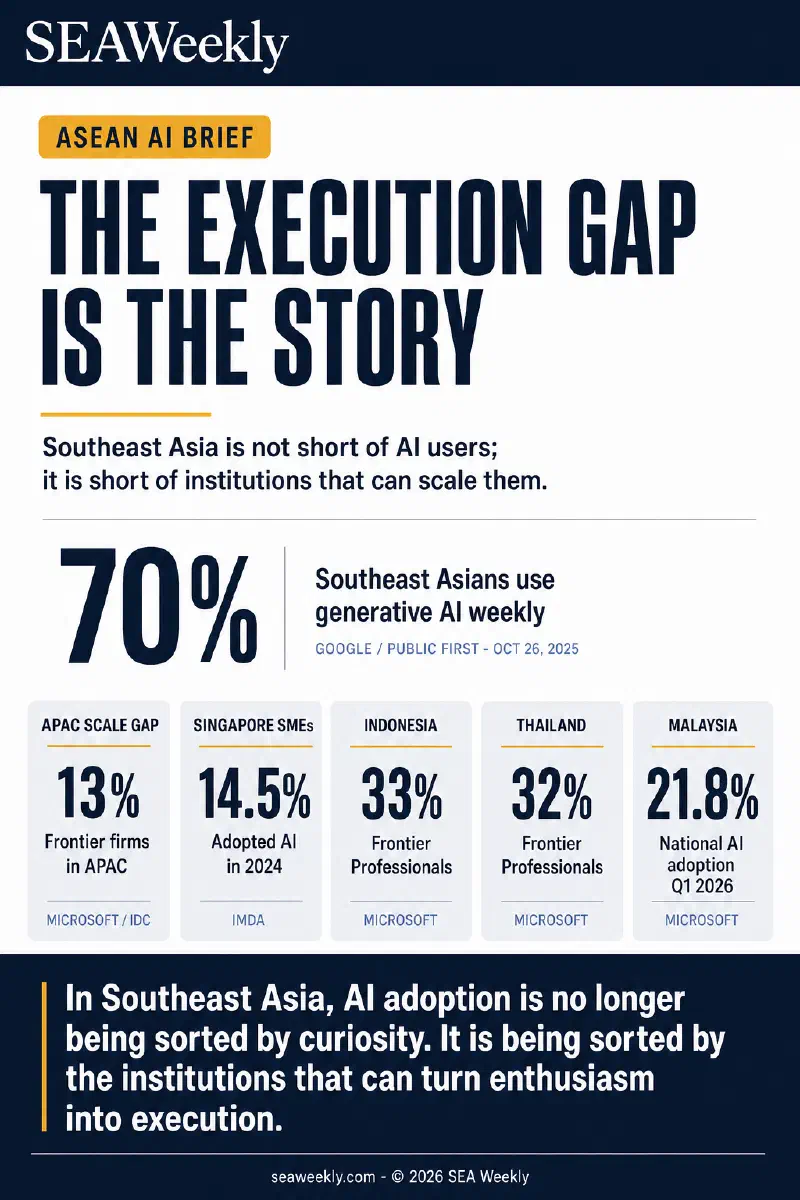
Google’s October 2025 note “Turning AI momentum in Southeast Asia into tremendous economic growth.” reports that 70% of people in the region already use generative AI tools weekly, a trajectory the company links to US$270 billion of regional economic value if that usage becomes output rather than novelty. Microsoft’s April 2025 APAC Work Trend Index added the enterprise view: 53% of APAC leaders are already using AI agents to fully automate workstreams or processes — the highest share of any region — while 52% of employees treat AI as a thought partner rather than a command line. Mass behaviour, not app experimentation.
Read those two figures against a third denominator before building a business case on either one. The e-Conomy SEA 2026 study by Google, Temasek and Bain & Company, published 21 October 2026, projects Southeast Asia’s digital economy at US$368 billion GMV for 2026, growing 17% year on year, and counts about 243 million generative AI users across the six major markets — roughly 58% of the working-age population. Same region, different frames: weekly tool use, share of the workforce, transaction value. Ratios move when the denominator changes, which is why the market has still not agreed what “mature adoption” should look like.
Cohorts at worker level are less ambiguous. Microsoft’s June 30 Work Trend Index update counted 33% of Indonesian workers as Frontier Professionals, more than double the 16% global average; its August 4 Thailand note put 32% of that workforce in the same band, its August 10 release put the Philippines at 25%, and Malaysia sits at 24%. Tech Wire Asia’s April 16 read of Stanford’s 2026 AI Index found more than 80% of respondents in Malaysia, Thailand, Indonesia and Singapore expecting AI to change their lives profoundly within three to five years, with reported generative AI adoption at 61% in Singapore against 28.3% in the US. Our July 11 brief on AI adoption in ASEAN trade finance stated the operational rule underneath those curves: the technology moves fastest where there is a concrete job to be done and a system dense enough to absorb it.

Why language fit and mobile beat budget
Because they remove friction that money cannot buy. Google’s July 14 report “How Gemini is speaking the language of Southeast Asia.” says active Gemini users in the region more than doubled in a year; Nearly 70% of prompts are submitted in native languages, led by Vietnam at 89%, Thailand at 87% and Indonesia at 84%. Almost three in four requests arrive on mobile devices, more than 40% use voice, photos or video, and roughly 40% ask the model to generate something new rather than retrieve information.
Architecturally this is a model-quality requirement disguised as a localisation feature. If a system cannot hold Thai nuance, Bahasa prompts or Vietnamese context with enough consistency to be useful, it remains a curiosity; if it can, usage deepens without a mandate because the cost of thinking inside somebody else’s interface drops out. The pull comes from the shop floor and the service desk, not from a CIO directive — and that is precisely the demand signal institutions then have to serve.
Where institutional execution breaks down
Between tool access and process redesign. Microsoft Singapore’s April 29 note “Fast AI adoption is not enough; Singapore must care about redesigning work.” states the ratio plainly: only 13% of organizations in Singapore and across Asia-Pacific qualify as frontier firms, against 31% in North America, even though enterprise uptake of agentic AI in Singapore was already 37% and still concentrated in a handful of functions rather than the operational core.
| Market | Worker-side signal | Organisation-side signal |
|---|---|---|
| Singapore | 61% reported generative AI adoption | 37% agentic uptake, but 13% frontier firms versus 31% in North America |
| Malaysia | 24% Frontier Professionals; 69% say they produce work they could not have created a year ago | only 32% say leadership is clearly and consistently aligned on AI |
| Thailand | 32% advanced AI users; 89% use AI output as the starting point for their own ideas | one-third of leaders actively reward experimentation; 60% of employees feel safer using AI to support old routines |
| Philippines | 25% Frontier Professionals; 77% producing work they could not have produced a year ago | 65% rank critical thinking as the top human skill; organisational factors outweigh individual mindset |
Microsoft calls the Thai pattern the “Transformation Paradox”: buy the new tool, protect the old process. The Philippines finding is the uncomfortable one for every leadership team that treats AI as a procurement question — culture, manager support and talent practices account for more than twice the impact of individual mindset and behaviour alone. Singapore’s regulator reached the same conclusion from its own data. The IMDA factsheet of March 2 launching the National AI Impact Programme, “National AI Impact Programme: Empowering Enterprises and Workers to Transform with AI.”, records SME adoption rising from 4.2% in 2023 to 14.5% in 2024 and non-SME adoption from 44% to 62.5%, then answers with targets instead of applause: 10,000 enterprises supported over three years and 100,000 workers made AI Bilingual. The AI for Enterprise Impact Playbook IMDA released in May, “New Playbook Charts a Clear AI Transformation Path for Local Enterprises.”, is more instructive still — the Grain case cut product-build time by 80% and administrative workload by 20%, but only after leadership, workforce training, data governance and daily operating habits were handled as one stack rather than four workstreams. It is the same conclusion this site keeps reaching on engineering and research programmes: models are not the hard part.
Which governance rails exist, and which are still paper
Adoption statistics outran the compliance calendar, and that gap now decides procurement risk market by market.
- ASEAN baseline is voluntary. The ASEAN Guide on AI Governance and Ethics (February 2024) and the Expanded Guide on Generative AI, unveiled 17 January 2025 by the ASEAN Working Group on AI Governance, set principles and practice areas — no filing duty, no penalty.
- Singapore is regulating the layer that breaks first. IMDA published its Model AI Governance Framework for Agentic AI in January 2026, guidance on how organisations deploy agents responsibly — aimed squarely at the workload class counted in the regional enterprise surveys.
- Vietnam has converted intent into statute. The Law on Digital Technology Industry (No. 71/2025/QH15), adopted 14 June 2025, takes effect on 1 January 2026, giving AI systems a legal frame and pushing data-heavy workloads toward documented controls.
- Thailand is still drafting. Risk-based rules and a draft royal decree covering business operations using AI remain in consultation through ETDA, so teams deploying agents this year run ahead of the text they will eventually be measured against.
The tradeoff cuts both ways: voluntary guides travel fast and bind nobody; statutes bind and lengthen sign-off cycles. Read the demand numbers against one operational question — who signs off when an agent acts — and the mismatch Tech Wire Asia named on April 16 stops being commentary and becomes a design input: “Southeast Asia leads the world in AI optimism. Its governance frameworks are nowhere near ready.”
Who is funding the missing middle
Singapore is building it as a translation layer. The NAIIP is not only a skilling scheme: 10,000 enterprises, 100,000 workers, more AI-enabled solutions under grant support and sector fluency programmes for law and accountancy. Google’s May 20 national AI partnership, “Accelerating AI impact in Singapore.”, ties health, education, enterprise engineering and safety benchmarks together instead of treating AI as a consumer app. The softer layer is being funded too: AI Ready ASEAN has equipped more than 800,000 young people, educators and parents, while Gemini Academy has trained more than 290,000 teachers across Indonesia, Malaysia, Thailand, Vietnam and the Philippines.
Malaysia pairs money, residency and skills. MDEC’s July 2025 release, “RM2.9 Million in Strategic Grants to Advance AI and Industrial Digitalisation.”, states the objective as commercialising local AI products rather than importing them, and under MDAG-AI eligible companies can claim up to 70% of total project costs, capped at RM2 million. Microsoft’s May 21 update on the country’s move from pilots to impact reported that the Malaysia West cloud region had made more than 190 services generally available locally and that national AI adoption rose to 21.8% in Q1 2026 from 19.7% in H2 2025; the April 24 Elevate Malaysia partnership adds the workforce side, with 80,000 learners already reached in the pilot phase and 800,000 Malaysians previously trained through AIForMYFuture.
Indonesia shows how fast the enablers compound once they line up. Microsoft’s March 12 note “Creating the Enablers for Indonesia’s AI Future.” reported that 92% of knowledge workers in the country were already using generative AI at work, above global and APAC averages, and tied adoption to hard inputs: a US$1.7 billion cloud and AI investment commitment, an estimated US$2.5 billion in new economic value around the Indonesia Central region, 106,295 projected jobs, 704,342 people already skilled, and elevAIte Indonesia targeting one million AI-skilled people by 2025.
One band that none of these programmes names directly is the firm between the two: 200 to 3,000 employees. The AIR APAC Mid-Market Readiness Index (inaugural edition, March 2026) scored 510 mid-market companies across Singapore, Australia, Malaysia, Indonesia and Thailand, and its authors are careful to note that a high readiness score only means a company is well positioned to adopt AI — not that it has deployed anything or redesigned a process. Vendors quoting readiness as a proxy for delivery should be read the same way.
Does the physical layer move the adoption curve
Increasingly, yes — but capacity claims and energised capacity are different assets. Tech Wire Asia’s February 25 report “Singtel building Southeast Asia’s AI power grid through Johor.” described a sovereign-capacity race around Singapore, Johor and Batam: Nxera’s new DC Tuas added 58MW of AI-ready capacity, more than 90% precommitted, with regional operational and pipeline capacity expected to exceed 400MW in the mid-term. Two independent readings complicate the headline. AMRO’s July 2026 assessment puts roughly 80% of Malaysia’s operational data centre capacity in Johor, and Reuters reported in late July 2026 that the state had attracted more than US$35 billion of data-centre investment while power and water availability became the friction. This is why the region’s compute build-out is better tracked as an operating constraint than as press-release news, in the same spirit as our playbook for cities building local AI compute.
What production actually looks like
Vietnam supplies the operational proof point. FPT Digital’s April 7 retail summit write-up, “Reshaping Vietnam’s Retai”, argued that AI can raise customer lifetime value by 20-30%, double conversion rates, halve the sales cycle and cut decision time by 40-60% — but only on top of a data foundation deep enough to trust. The Long Chau Pharmacy case is the more useful artefact: a Data Lakehouse built in 2023, AI layered into logistics and warehousing, and a 50% reduction in manual workload. A lakehouse is not a silver bullet; it moves transaction and warehouse complexity into the table-format layer, and somebody still has to decide who writes, who reads, and who is accountable when a model trained on that table makes a wrong call. That is what adoption looks like once it stops being a board slide.
Frequently asked questions
Is Southeast Asia ahead of the US and Europe on AI?
On individual usage behaviour, by several measures: 61% reported generative AI adoption in Singapore against 28.3% in the US, and 33% of Indonesian workers classed as Frontier Professionals against a 16% global average. On organisation design, no: 13% of Asia-Pacific firms qualify as frontier firms versus 31% in North America.
Why do adoption statistics for the same market disagree?
Because they use different denominators and windows — weekly tool use (70%), working-age population (about 58% in e-Conomy SEA 2026), enterprise agentic uptake (37%), national adoption (21.8% in Malaysia’s Q1 2026 reading). Quote the frame or the number means nothing.
What should an enterprise buyer verify first?
Three things, in order: native-language performance on your own prompt set, data residency and locality of the services you depend on, and a named owner for agent decisions. Grant money and model access sit below all three.
Where is the fastest realistic payoff?
Where data foundations already exist. Long Chau Pharmacy’s 50% reduction in manual workload came after a lakehouse, not before it; Grain’s 80% cut in build time came after leadership, training and governance moved together.
Decision checklist before scaling a second AI workflow
- Can you name the accountable owner of every agent now in production, and its rollback path?
- Is your evaluation set written in the language staff actually prompt in — the region’s own benchmark at 89% Vietnam, 87% Thailand, 84% Indonesia?
- Does the data layer record who wrote each table that feeds a model, or only who reads it?
- Which process has been redesigned rather than merely assisted — the gap between 37% uptake and 13% frontier firms is measured here.
- Is training money tied to process change rather than seat licences, the logic behind 100,000 AI Bilingual workers and one million skilled Indonesians?
- Which instrument governs you where you deploy: the voluntary ASEAN guides, Singapore’s agentic framework of January 2026, Vietnam’s statute from 1 January 2026, or Thailand’s draft decree?
- Is the compute you contracted energised rather than announced — 58MW at DC Tuas with more than 90% precommitted, inside a 400MW pipeline that still has to clear power and water?
Curiosity is no longer the sorting mechanism in this region. The institutions that can turn high-frequency experimentation into governed, repeatable, sector-specific routines will compound it; the rest will keep buying tools and protecting old processes. — Oscar Murphy, AIdataNewsGlobal (AI & Data News). Corrections and tips: editorial@aidatanews.com
References
Master-listed sources, all accessed August 16, 2026; additional sources cited at the point of use.